Plastic Recycling Machine Manufacturer in China — PE, PP & PET Granule Extruders
TWMACHINE manufactures single stage and double stage plastic recycling machines that turn waste film, agricultural film, raffia and post-consumer packaging into usable granules. The single stage machines process clean, sorted material in one step; the double stage machines add a second extruder, which means the material is melted, filtered and re-pelletised, so dirty or lightly contaminated input can still be brought up to a consistent granule quality. This page lists the real factory data for both platforms — screw diameter, L/D ratio, temperature control zones, drive power, output in kilograms per hour, footprint and weight — so you can size the machine against the material you actually have.
Our Plastic Recycling Machine Range
Each card links to the full specification sheet and price list. The comparison table and selection guide that follow use the same factory data.

What Is a Plastic Recycling Machine?
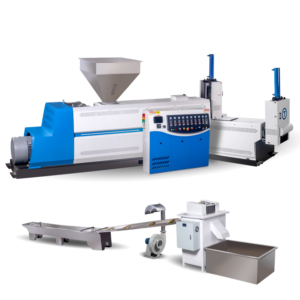
A plastic recycling machine is a compactor extruder: it melts cleaned waste plastic and pushes it through a die plate that cuts the melt into pellets. The polymer is fed into the barrel, where the screw conveys, compresses and plasticises it, then a screen changer filters out remaining solid contamination before the melt reaches the die. The pellets are cooled, dried and cut to the required length.
The difference between the two platforms is the number of extruders. A single stage machine does the whole job in one barrel, which makes it cheaper and simpler but requires clean, sorted, consistent input. A double stage machine uses a primary extruder to melt and degas the material and a secondary extruder with a longer L/D ratio to further homogenise and filter it. The second stage is what allows the machine to handle material with some moisture or mixed polymer types, and to hold a tighter tolerance on the final granule.
Both platforms in this range run PE, PP and PET. PET needs a specific configuration, because the drying and the melt temperature for PET are higher than for polyolefins, and the die and screw have to be sized accordingly.
Recycling Machine Models and Technical Specifications
The table compares the single stage and double stage machines across the screw sizes available in each series.
| Model | Type | Screw diameter (mm) | Screw L/D | Temperature zones | Drive motor (kW) | Output (kg/h) | Machine size (mm) | Weight (kg) |
|---|---|---|---|---|---|---|---|---|
| 100 | Single stage | 100 | 18:1 / 22:1 | 4 | 18.5 | 60–80 | 2500 × 1000 × 1200 | 1600 |
| 110 | Single stage | 110 | 20:1 / 24:1 | 5 | 22 | 100–150 | 2700 × 1200 × 1350 | 1700 |
| 120 | Single stage | 120 | 22:1 / 24:1 | 5 | 37 | 120–200 | 3000 × 1500 × 1450 | 1800 |
| 130 | Single stage | 130 | 22:1 / 24:1 | 6 | 45 | 150–250 | 3200 × 1500 × 1450 | 1900 |
| 140 | Single stage | 140 | 20:1 / 24:1 | 7 | 55 | 200–300 | 3600 × 1500 × 1500 | 2000 |
| 120 | Double stage | 120 / 110 | 18:1 / 10:1 | 8 | 41 | 100–200 | — | 2200 |
| 140 | Double stage | 140 / 120 | 20:1 / 10:1 | 9 | 63.5 | 200–400 | — | 2400 |
| 160 | Double stage | 160 / 130 | 25:1 / 10:1 | 10 | 73.5 | 250–500 | — | 2600 |
| 180 | Double stage | 180 / 140 | 25:1 / 10:1 | 10 | 97 | 250–500 | — | 2800 |
| 200 | Double stage | 200 / 160 | 25:1 / 10:1 | 10 | 97 | 250–500 | — | 3000 |
Note how the double stage machines reach their output with a smaller primary screw than the single stage machines: the 160 model with a 160/130 screw combination produces 250 to 500 kg/h, while the single stage 140 machine tops out at 200 to 300 kg/h. That is the practical advantage of the second extruder, and it is why the double stage machines are usually the better choice once output matters more than capital cost.
Main Applications of Plastic Recycling Machines
- Agricultural film recycling — greenhouse film, mulch film and silage wrap, which are typically LDPE and LLDPE and often dirty, making the double stage machines the usual choice.
- Shopping bag and packaging film recycling — clean HDPE and LDPE offcuts and reject film from a bag making line, which usually runs on a single stage machine.
- Injection and blow moulding feed stock — granules produced here go straight back into an injection moulding or blow moulding line, which is the most common closed loop arrangement in practice.
- Raffia and woven sack recycling — PP raffia tape and woven sack cloth, which are high filler loads and need a robust screw and a good screen changer.
- PET bottle recycling — PET needs a PET specific configuration with higher melt temperature and careful drying, and is normally specified separately.
- Colour and filler masterbatch — the same extruders are used to compound masterbatch and filled compounds with a second extruder for dispersion.
How to Choose the Right Plastic Recycling Machine
Output and material cleanliness are the two inputs that decide the machine. Everything else — screw size, die, cutter and cooling — follows from them.
- How much material do you have — multiply your available tonnage per month by the actual running hours. The single stage 110 handles 100 to 150 kg/h and the double stage 160 handles 250 to 500 kg/h, so the difference is roughly a threefold step in plant size.
- How clean is the input — sorted, single-polymer, relatively clean film runs on a single stage machine. Contaminated, mixed or moist material needs a double stage machine, because the secondary extruder degasses and filters what the primary one cannot handle alone.
- Which polymer — PE and PP run on standard machines. PET needs a higher melt temperature range and a PET specific screw and die, and the granule output has to be dried before use. Tell us the polymer and we will configure the machine for it.
- Granule size and shape — the die plate and the cutter set the pellet diameter and length. Cutter and die are build options, and they should be matched to the extrusion downstream that will consume the granules.
- Filtration — a continuous screen changer allows production without stopping for a filter change, and is worth specifying if you change material batches often or need to keep contamination out of a high quality product.
- Space and power — the machines weigh 1.6 to 3 tonnes and need three phase 380 V supply. The double stage machines also need an auxiliary extruder frame and a larger footprint for the same output rating.
Why Buyers Choose TWMACHINE
- Both platforms from one workshop. Single and double stage machines built in the same facility, so the screw, gearbox and die know-how is shared rather than bought in.
- Factory-direct pricing. The screw, barrel, gearbox and die are made in house, which is what keeps the price of the larger double stage machines competitive.
- Real L/D ratios published. The single stage machines run up to 24:1 and the double stage primary screws up to 25:1, with a 10:1 secondary extruder for degassing and filtration. These are the numbers that decide granule quality.
- Configured to your material. Screw size, die plate, cutter, screen changer type, cooling and cutting system, and the motor are specified per order.
- Service and wear parts. Screws, barrels, screen changers, die plates, heaters and thermocouples are supplied from stock, with machine dimensions, weight and power confirmed on the order for foundation planning.
Frequently Asked Questions
When is a double stage machine worth the extra cost?
When the input is not clean and consistent. A single stage machine can produce good granules from sorted, single-polymer, relatively dry material. If the feed contains moisture, mixed polymer types or a significant amount of fine contamination, the single stage struggles and the granules come out inconsistent. The double stage machine melts and degasses in the primary extruder and then filters and homogenises in the secondary, which is what raises the output quality. It also reaches a given output with a smaller primary screw, so for anything above roughly 250 kg/h it is usually the cheaper choice overall once the second extruder is counted.
How much material preparation is needed before recycling?
The machine handles the final melting and filtration, but it cannot remove foreign matter such as sand, stones, paper, metal or mixed plastics, because those destroy the screw and the screen changer. A typical line needs washing or dry cleaning, a shredder, a magnet for ferrous metal, and a granulator to reduce the film to flakes before extrusion. The required line depends entirely on the waste stream, and it is worth designing the whole line with us rather than buying the extruder on its own.
Can these machines recycle PET?
Yes, but PET needs a specific configuration rather than a standard PE or PP setup. The melt temperature range is higher, the screw and die are sized for the higher viscosity, and the material has to be dried properly before extrusion — otherwise the moisture causes chain degradation and the granules come out yellow and brittle. Tell us that PET is the target material and we will specify the screw, barrel, die, temperature zones and drying requirement accordingly.
What output can I realistically expect?
The published figures are the factory output rates for the stated screw and material. Actual output depends on the melt filtration, the screen changer cycle, the granule size and how often the material has to be changed. In practice, budget on the lower end of the range for difficult material and for frequent grade changes, and treat the peak figures as the condition where the material, the filtration and the cooling are all running optimally.
Request a Quotation
Send us the material, the monthly tonnage, the level of contamination and the granule size you need. We will recommend single or double stage and the correct screw size, with a full specification sheet, a foundation and power layout drawing and an indicative price. If you are planning a complete recycling line rather than a single extruder, send the waste stream details as well and we will quote the line.