Film Blowing Machine Manufacturer in China — PE Film Extrusion & AB/ABA Co-extrusion
TWMACHINE has manufactured film blowing machines since 2008 for converters who want to produce their own PE film instead of buying it. This page covers the single screw machines for HDPE, LDPE and LLDPE, and the double layer AB and ABA co-extrusion machines, with the real factory data for each model: screw diameter, L/D ratio, die size, maximum film width, thickness range, output in kilograms per hour, drive power and take-up specification. Whether you are supplying film to your own bag making line or selling film rolls to other converters, the selection guide below shows where each machine fits.
Our Film Blowing Machine Range
Each card links to the full specification sheet and price list. The comparison table and selection guide that follow use the same factory data.
What Is a Film Blowing Machine?
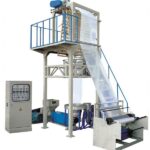
A film blowing machine extrudes plastic pellets into a continuous tubular film. The pellets are melted in the barrel of a single screw, pushed through a die head that forms a bubble, and inflated by air inside the bubble to stretch the melt into a thin film tube. The tube is cooled, collapsed by collapsing guides and taken up as a flat film roll on a winder. Because the film is stretched in both directions, the output is stronger than cast film of the same thickness, and the machine can run very thin gauges — down to 0.008 mm on the single screw models.
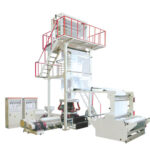
The AB and ABA machines are co-extrusion designs with two or three extruders feeding one die head. The core layer provides the strength and the barrier layer carries the surface treatment, while the outer layers can be a different, cheaper or more printable material. This is how a converter gets a three-layer film with different properties on each side from a single production step, and it is the normal choice for high-barrier packaging film, stretch film and shopping bag film.
Film Blowing Machine Models and Technical Specifications
The table compares the single screw and double layer machines. The screw, barrel and die head are 38CrMoAlA alloy, the standard for blown film equipment, because it resists the corrosive effect of PVC and the heat of the melt.
| Model | Type | Materials | Max. width (mm) | Thickness (mm) | Max. output (kg/h) | Screw | Main motor | Total power |
|---|---|---|---|---|---|---|---|---|
| TW-A50 | Single screw | HDPE, LDPE, LLDPE | 600 | 0.008–0.15 | 35 | φ50, L/D 28:1 | 11 kW | — |
| TW-A55 | Single screw | HDPE, LDPE, LLDPE | 800 | 0.008–0.15 | 55 | φ55, L/D 28:1 | 15 kW | — |
| TW-A60 | Single screw | HDPE, LDPE, LLDPE | 1000 | 0.008–0.15 | 65 | φ60, L/D 28:1 | 18.5 kW | — |
| TW-A65 | Single screw | HDPE, LDPE, LLDPE | 1200 | 0.008–0.15 | 80 | φ65, L/D 28:1 | 22 kW | — |
| TW-2L 55 | Double layer AB / ABA | LDPE, LLDPE, HDPE, MLDPE | 500–1000 | 0.03–0.15 | 90 | φ55 × 2, L/D 28:1 | 15 kW × 2 | 50 kW |
| TW-2L 60 | Double layer AB / ABA | LDPE, LLDPE, HDPE, MLDPE | 700–1200 | 0.03–0.15 | 110 | φ60 × 2, L/D 28:1 | 18.5 kW × 2 | 60 kW |
| TW-2L 70 | Double layer AB / ABA | LDPE, LLDPE, HDPE, MLDPE | 800–1500 | 0.03–0.15 | 130 | φ65 × 2, L/D 28:1 | 22 kW × 2 | 180 kW |
Note the difference in minimum thickness: the single screw machines run from 0.008 mm, which is thin enough for carrier tape, shrink film and very light shopping bags, while the co-extrusion machines start at 0.03 mm because each layer needs enough melt to flow evenly. The co-extrusion machines also carry a higher installed power — 50 to 60 kW on the smaller machines — because two extruders run at once.
Main Applications of Film Blowing Machines
- Shopping and T-shirt bag film — HDPE and LDPE film for side sealing and bottom sealing bag machines, typically 0.008 to 0.03 mm.
- Shrink and stretch film — the double layer machines produce high shrink ratio film for pallet wrap and shrink sleeves, where the barrier layer matters.
- High barrier packaging film — ABA co-extrusion with PA, EVOH or PVDC as the core layer for food packaging that needs oxygen and moisture barrier.
- Carrier tape and packaging tape — very thin film from the single screw machines for electronic component packaging and BOPP tape base material.
- Garbage bag film — HDPE at 0.007 to 0.02 mm for the drawstring and T-shirt garbage bag machines.
- Agricultural and construction film — thicker LDPE and LLDPE film for greenhouse covering, silage wrap and mulch film.
How to Choose the Right Film Blowing Machine
Output and layer count drive the decision. Work from the film you need to make, not from the machine you would like.
- Output required — divide your monthly film requirement by the number of working days and hours to get kilograms per hour, then add headroom of 20 to 30 percent for grade changes and downtime. The TW-A55 produces 55 kg/h and the TW-2L 60 produces 110 kg/h.
- Single layer or co-extrusion — if one material does the job, the single screw machines are simpler and cheaper to run. Co-extrusion only earns its cost when you need a barrier layer, a printable surface layer, or a cheaper core material.
- Film width — the maximum width has to match the widest roll your downstream machine can take. The TW-A50 makes 600 mm film, the TW-A65 makes 1200 mm, and the TW-2L 70 reaches 1500 mm.
- Thickness range — very thin film down to 0.008 mm needs a well-designed die and precise temperature control. If your product is 0.03 mm or heavier, the co-extrusion machines are the better platform.
- Take-up and winding — the single screw machines use a double type surface friction winder with a 10–60 m/min take-up speed. If you need automatic roll change without stopping, specify an automatic roll changer.
- Space and power — the co-extrusion machines need three phase supply and roughly 50 to 60 kW, plus a rotary die head, air ring and a larger take-up. Plan the floor area and the electrical supply before the order.
Why Buyers Choose TWMACHINE
- Single screw and co-extrusion under one roof. If your business grows from plain PE film into barrier film, the machine supplier stays the same and the platform is familiar to your operators.
- 38CrMoAlA throughout. Screw, barrel and die head in the same alloy, which is what resists wear and corrosion at continuous melt temperatures.
- Rotary die head included. The single screw machines come with a 360 degree rotating die head and the co-extrusion machines with an ABA co-extrusion die, so uniform gauge around the bubble is built in rather than added later.
- Factory-direct pricing. The extruder, gearbox, die head and winder are built in our own workshop, which is what decides the price on high output machines.
- Configured to your film. Screw size, die gap, air ring, output, take-up speed, winder type, screen changer and automatic roll changer are specified per order.
Frequently Asked Questions
What is the difference between AB and ABA blown film?
AB is a two layer structure: a core layer with a single skin layer. ABA is three layers, with the same core material and a different material on both outer surfaces. The outer layers decide how the film behaves on the print and sealing side, while the core provides the mechanical strength and any barrier property. In practice ABA is used when a converter needs one face to print well and the other face to seal well, or when the surface layer has to be a different, more expensive resin than the core.
How thin a film can these machines produce?
The single screw machines run from 0.008 mm, which is the practical limit for blown HDPE and LDPE without an extremely fine die gap and very stable melt temperature. The double layer co-extrusion machines start at 0.03 mm because each layer needs enough melt to distribute evenly across the die. If your film is thinner than 0.008 mm, cast film is normally the better process rather than blown film.
Do the machines come with a screen changer?
The extruders are supplied with a screen changer as standard, which is essential for production because the melt has to be filtered before it reaches the die. Continuous screen changers, which do not stop the line, are available as an option and are worth specifying if you change material frequently or need to keep contamination out of a barrier film.
What materials can be blown on these machines?
The single screw machines run HDPE, LDPE and LLDPE. The double layer machines add MLDPE, which is a metallocene grade used for high strength and downgauging, and they can be configured for ABC, ABCP and other multi-layer structures. For PVC or corrosive resins, the screw, barrel and die head need a higher alloy grade, which we can supply as an option.
Request a Quotation
Send us your material, film width, thickness, required output in kilograms per hour and monthly volume. We will recommend the single screw or co-extrusion configuration that fits, with a full specification sheet, a foundation and power layout drawing and an indicative price. Because these machines are built to order, the more accurate your film specification, the more accurate the machine we quote.